Waist-to-height ratio calculator
Your recorded waist: the tape readings averaged and rounded down to the ½ inch¶3.15.4.5. Have three readings? Work out the recorded waist.
Shoes off, recorded to the nearest ½ inch ¶3.15.2.2, 3.15.2.3.
Truncated, not rounded. Rounding 0.5486 would give 0.55 and 12.5 points; the AFMAN cuts it to 0.54, so you score 15 ¶3.15.4.2.
How far to the next band
Waists on the ½-inch grid they are recorded on, scored with the same truncation.
Waist 38.5 in or less (0.53)
or less (ratio 0.49 or below)
or less keeps you at .55 or below.
Your waist table at 6 ft 0 in (72 in)
The recorded waists that earn each step on the chart, for your height.
| Points | WHtR | Recorded waist | Risk |
|---|---|---|---|
| 20 | 0.49 or less | 35.5 in or less | Low risk |
| 19 | 0.50 | 36.0–36.5 in | Moderate risk |
| 18 | 0.51 | 37.0 in | Moderate risk |
| 17 | 0.52 | 37.5–38.0 in | Moderate risk |
| 16 | 0.53 | 38.5 in | Moderate risk |
| 15You | 0.54 | 39.0–39.5 in | Moderate risk |
| 12.5 | 0.55 | 40.0 in | High risk |
| 10 | 0.56 | 40.5–41.0 in | High risk |
| 7.5 | 0.57 | 41.5 in | High risk |
| 5 | 0.58 | 42.0 in | High risk |
| 2.5 | 0.59 | 42.5–43.0 in | High risk |
| 0 | 0.60 or more | 43.5 in or more | High risk |
At 72 in, each ½ inch of waist moves the ratio by 0.0069, and one chart step is 0.01. That is why a ½-inch difference on the tape can cost 1 point in the moderate band or 2.5 points in the high band.
From three tape readings to your recorded waist
Recorded to the nearest ½ inch ¶3.15.2.3. Sent to the calculator with the waist.
- Each reading is rounded down to the nearest ½ inch.
- If any of them differ by more than one inch, a fourth measurement is taken.
- The three closest are added together and divided by three.
- That average is rounded down to the nearest ½ inch: your recorded waist.
Why your number moves between tapings: every reading is rounded down, then the average is rounded down again. A reading of 34.4 in counts as 34.0, and a quarter inch of tape position can move a reading across a ½-inch line. Practice the official placement below and measure at the same point every time.
The Official WHtR Chart
Body composition is worth up to 20 of the 100 points: cardio carries 50, strength and core 15 each ¶3.7.1. Unlike those three, it has no minimum, and one table applies to every age and both sexes ¶3.1, 3.15.4.2. These are the AFPC chart values the calculator uses:
| WHtR (truncated) | Points | Risk (chart key) |
|---|---|---|
| 0.49 or less | 20 | Low risk |
| 0.50 | 19 | Moderate risk |
| 0.51 | 18 | Moderate risk |
| 0.52 | 17 | Moderate risk |
| 0.53 | 16 | Moderate risk |
| 0.54 | 15 | Moderate risk |
| 0.55 | 12.5 | High risk |
| 0.56 | 10 | High risk |
| 0.57 | 7.5 | High risk |
| 0.58 | 5 | High risk |
| 0.59 | 2.5 | High risk |
| 0.60 or more | 0 | High risk |
The ratio is truncated, not rounded, before it is looked up ¶3.15.4.2. 39.5 ÷ 72 = 0.5486 is recorded as 0.54 and scores 15 points, not the 12.5 that rounding to 0.55 would give.
Maximum waist by height
Waists are recorded rounded down to the ½ inch ¶3.15.4.5, so these are the largest recorded waists that still earn each line, worked out with the same truncation. For your exact height, use the calculator.
| Height | 20 pts≤ 0.49 | 15 pts0.54 | .55 line12.5 pts | 0 ptsfrom |
|---|---|---|---|---|
| 4′10″58 in | 28.5 | 31.5 | 32.0 | 35.0 |
| 5′0″60 in | 29.5 | 32.5 | 33.5 | 36.0 |
| 5′2″62 in | 30.5 | 34.0 | 34.5 | 37.5 |
| 5′4″64 in | 31.5 | 35.0 | 35.5 | 38.5 |
| 5′6″66 in | 32.5 | 36.0 | 36.5 | 40.0 |
| 5′8″68 in | 33.5 | 37.0 | 38.0 | 41.0 |
| 5′10″70 in | 34.5 | 38.0 | 39.0 | 42.0 |
| 6′0″72 in | 35.5 | 39.5 | 40.0 | 43.5 |
| 6′2″74 in | 36.5 | 40.5 | 41.0 | 44.5 |
| 6′4″76 in | 37.5 | 41.5 | 42.5 | 46.0 |
| 6′6″78 in | 38.5 | 42.5 | 43.5 | 47.0 |
Waists in inches. “.55 line” is the largest waist that keeps the recorded ratio at 0.55 or below, the edge of the Tier 2 trigger (a WHtR above .55).
Worked examples
5 ft 10 in (70 in), 34-inch waist: 34 ÷ 70 = 0.4857 → 0.48. Low risk, 20 points.
6 ft 0 in (72 in), 39.5-inch waist: 39.5 ÷ 72 = 0.5486 → 0.54. Moderate risk, 15 points, not 12.5.
6 ft 0 in (72 in), 44-inch waist: 44 ÷ 72 = 0.6111 → 0.61. 0 points, but you can still pass with 75 from the other 80. If you don't, a Tier 2 BFA follows.
See your full PFRA with the PT score calculator, every event chart on the score charts page, and the pass rules on PT test minimums.
How the Tape Is Placed: The Official Procedure
The administrator reads you the instructions in Attachment 2 ¶A2.2 and measures you before any other component ¶3.15.4.1. This is everything AFMAN 36-2905 (formerly DAFMAN 36-2905) specifies.
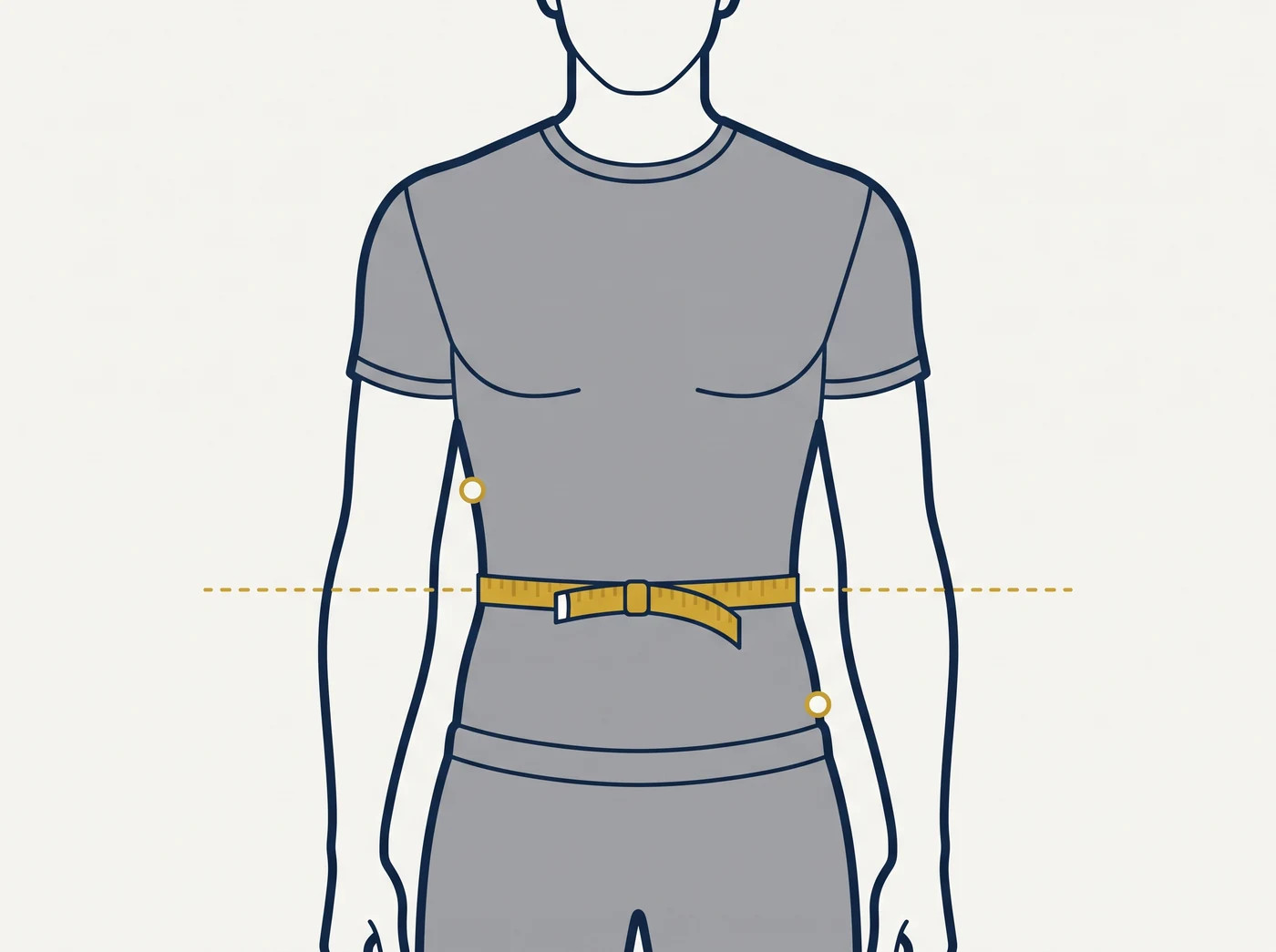
- Who measures you
- A PFRA Administrator of the same sex, or a same-sex chaperone must be present ¶3.15.4.3. Any duty uniform is fine for this component ¶3.2.2; you adjust it so the tape sits on skin.
- The tape
- Non-stretch material, marked in inches ¶3.15.4.3.
- Where
- The midpoint between your lowest rib and the top of your hip bone (iliac crest), on bare skin, from the right side of the waist ¶3.15.4.5, 3.15.4.6.
- How tight
- Flat on the skin and not compressing it ¶3.15.4.6.
- Your stance
- Flat surface, feet no more than shoulder width apart, head level and looking forward, body straight but not rigid, like the position of attention ¶3.15.4.4.
- Your hands
- You may move clothing out of the way and hold the tape once the midpoint is found. Then let go and relax your arms at your sides before it is read ¶3.15.4.4, A2.2.2.
- Breathing
- No holding your breath or sucking in. The reading is taken at the end of a normal exhale ¶3.15.4.4.
- Three readings
- Each rounded down to the ½ inch; one more if any differ by more than an inch; the three closest averaged and rounded down to the ½ inch ¶3.15.4.5, A2.2.3.
- Height
- Shoes off, on a calibrated stadiometer or wall-mounted device, head level, recorded to the nearest ½ inch ¶3.15.2.1–3.15.2.3.
- Not the BFA tape sites
- The navel (men) and the narrowest “natural waist” (women) are the Tier 2 BFA sites Tables A8.1, A8.2, not the WHtR site.
Practicing at home: find the bottom of your ribs and the top of your hip bone with your fingers, measure at the midpoint on bare skin with the tape level, and read it at the end of a relaxed breath out. Take three readings and run them through the tape-readings tool so you see the number the administrator would record.
What happens above .55
A WHtR of .55 or more is not an automatic fail. Body composition has no minimum ¶3.7.1, so a high ratio only costs points. The .55 line matters in one case: when your PFRA does not meet standards ¶3.1.1.
The flowchart in words
- Your waist-to-height ratio is measured and scored from 0 to 20 points. Body composition has no minimum ¶3.7.1.
- If the PFRA meets standards (a composite of 75 or more with every component minimum met), that is the end of it, even with a WHtR of .55 or more ¶3.1, 3.6.1.
- If it does not, and your WHtR is not above .55, the result is an Unsatisfactory PFRA and enrollment in the Fitness Reconditioning Program (FRP) ¶3.6.1, 5.6.1.
- If it does not and your WHtR is above .55, you take a Tier 2 Body Fat Assessment: on an InBody 770 scale if one is available, otherwise by the 2–3 site tape method ¶3.1.1, 3.1.2.1.1–3.1.2.1.3, 3.15.4.7.
- Under the standard (men under 26%, women under 36%) Table 3.2, body composition is scored as an exempt component and the composite is recalculated on the other components ¶3.7.2. If that recalculated PFRA meets standards, you pass.
- At or over the standard, you receive an Unsatisfactory PFRA and enter the FRP ¶3.7.2, 5.6.2.
10 strength + 10 core + 43 cardio + 5 body composition (WHtR 0.58) = 68: Unsatisfactory. The WHtR is above .55, so a BFA follows. Pass it and body composition drops out: 63 of the 80 points still possible is 78.8, a pass. The AFMAN does not print the formula for a composite with an exempt component; this site pro-rates (points earned ÷ points possible × 100).
Try your own numbers in the PT calculator, or estimate a tape-method result with the Tier 2 BFA estimator below.
Tier 2 Body Fat Assessment estimator (tape method)
Shared with the WHtR calculator above. Recorded to the nearest ½ inch ¶3.15.2.3.
Where each tape goes
- Neck: looking straight ahead, shoulders down, just below the larynx (Adam's apple). The tape usually angles down slightly toward the front, like a shirt collar. Rounded up to the ¼ inch.
- Abdomen: arms at your sides, at the end of a normal relaxed exhale, around the navel with the tape level all the way round. Rounded down to the ¼ inch.
- Same-sex administrator ¶3.1.2.1.3. These sites are different from the WHtR waist site. Source: Table A8.1
| Site | Entered | Recorded |
|---|---|---|
| Neck | 16.5 | 16.50rounded up to ¼ in |
| Abdomen (at the navel) | 40.5 | 40.50rounded down to ¼ in |
| Height | 72 | 72.0nearest ½ in |
| Circumference value | 40.50 − 16.50 = 24.00 | |
Three Things People Confuse
“WHtR” now means three different things. Only the first one is on your PFRA.
Measured by a PFRA Administrator as the first component of your PFRA, or up to five duty days before it ¶3.1.1, 3.15.4.1. Worth 0–20 points with no minimum ¶3.7.1. Above .55 it matters only if the PFRA does not meet standards ¶3.1.1.
Sources: AFMAN 36-2905, 24 March 2026; start of official scoring, af.mil, 23 July 2026.
A 9 July 2026 memo directed a one-time WHtR “biometric data collection”, logged in the new myBodyComp app by 31 July (ARC: 31 August). The Chief of Staff wrote, “You must have a current WHtR assessment uploaded in myBodyComp” (CSAF Letter to the Force, 13 July 2026).
It “is not part of the Physical Fitness Readiness Assessment and will not affect fitness scores, test currency or other personnel actions” (af.mil, 23 July 2026). Task & Purpose reported the Air Force’s clarification that it “is not scored and will not drive personnel actions” (Task & Purpose, 27 July 2026).
Not required with a full AF Form 469 medical exemption, a pregnancy or postpartum exemption, or an approved retirement or separation within 12 months (af.mil, 23 July 2026).
The Department of War’s physical fitness and body composition instruction (DoWI 1308.03, effective 31 August 2026) replaced the 2022 DoDI 1308.03. Military Times reports that it sets a DoD-wide WHtR standard below 0.55 (Military Times, 9 September 2026).
As of 2 October 2026 we have found no Air Force implementation guidance and no change to AFMAN 36-2905, whose rule is still the .55 trigger described above. Watch for Air Force guidance.
Lowering Your WHtR, Health First
The tape moves in months, not days. The Air Force’s Warfighter’s Fitness Playbook 2.0 (Feb 2026) puts healthy weight loss at 1–2 pounds a week, or 1–3% body fat a month, and suggests re-measuring body composition about every two months to see real change (p. 20).
Skip restrictive fad diets: the Playbook says they are not sustainable and can cause harm long-term (p. 19). A deficit you can keep for months beats one you quit in two weeks.
Lean protein and fiber at each meal help you stay full; aim for 25–30 g of fiber a day (Playbook p. 19).
At least two days of resistance training a week on top of your cardio, to keep muscle while you lose fat (Playbook p. 19). Your run training for the 50-point cardio component helps the waist too.
Keep a consistent sleep and wake time, even on weekends (Playbook p. 12).
Steps, chores and mobility sessions add up (Playbook p. 19).
Restaurant meals often contain high calories, salt and fat; cooking at home puts you in control (Playbook p. 19).
The Playbook warns against losing more than 2% of body weight a week (p. 20) and lists dehydration as a heat-stress risk factor (p. 8). On test day the run or HAMR follows the tape ¶3.15.4, and sucking in or holding your breath is not allowed anyway ¶3.15.4.4. Eat and drink normally.
Get help, free: Military OneSource health and wellness coaching covers fitness, nutrition and weight management at no cost to eligible service members (800-342-9647). If you are in the Fitness Reconditioning Program, your options can include Military OneSource health coaching, fitness center exercise classes, medically approved nutrition courses and local FRP classes ¶5.6.5. For a plan built around you, the Playbook points to a registered dietitian (p. 18).
If a medical condition affects your body composition, talk to your provider. A body composition exemption has to be reviewed and approved by the AMRO Board ¶4.1.8.2. For a week-by-week approach, read how to lower your waist-to-height ratio.
Frequently Asked Questions
Is a WHtR of .55 or higher an automatic fail?+
What waist-to-height ratio gets full points?+
How is the waist measured for the WHtR?+
Is the WHtR rounded or truncated?+
What is a Tier 2 Body Fat Assessment (BFA)?+
What happens if I fail the Tier 2 BFA?+
Does the WHtR standard change with age or sex?+
Can I do the waist measurement on a different day from the rest of the PFRA?+
Did the July 2026 myBodyComp measurement count toward my PT score?+
More in Body Composition
See exactly where you stand.
Enter your reps, times and waist measurement to get your 2026 PFRA score instantly.