The One Component You Cannot Cram
Push-ups improve in weeks and pacing improves in days, but a waist measurement moves over months. That makes WHtR the first thing to start on when a test date appears. The points side (full 20 at 0.49 or less, zero at 0.60 or more, no minimum ¶3.7.1) is on the WHtR scoring guide, with a calculator that shows the waist for every points step at your height. This page is the plan for moving the number.
Timeline by Starting Ratio
The Air Force’s Warfighter’s Fitness Playbook 2.0 (Feb 2026) puts healthy weight loss at 1–2 pounds a week, or 1–3% body fat a month, and suggests re-measuring body composition about every two months to see real change (p. 20). At 5 ft 10 in, the full-points waist is 34.5 in and the .55 line is 39.0 in: 4.5 inches apart.
- WHtR 0.49 or less20 pts
Full points.
Maintain your habits and protect run performance.
- WHtR 0.50–0.5419–15 pts
Each 0.01 step is worth 1 point.
One step is 0.01 × your height (0.7 in at 5 ft 10 in). The calculator gives your exact waist for each step.
- WHtR 0.55–0.5912.5–2.5 pts
Each step is worth 2.5 points. Above .55, a PFRA that does not meet standards leads to a Tier 2 BFA ¶3.1.1.
The most points per inch on the chart. Plan in months and re-measure about every two months (Playbook p. 20).
- WHtR 0.60 or more0 pts
No points, but no minimum either ¶3.7.1: you need 75 from the other 80.
Start now, and bring in your provider and the free coaching below.
What Works (and What Backfires)
1–2 pounds a week is the Playbook's healthy rate (p. 20). Skip restrictive fad diets: not sustainable and can cause harm (p. 19).
Energy spent in exercise is part of body composition change (Playbook p. 20), and it trains the 50-point cardio component (AFMAN 36-2905 para. 3.7.1).
On top of cardio, to keep muscle while you lose fat (Playbook p. 19).
Protein and fiber at every meal, 25–30 g of fiber a day (p. 19); 7–9 hours of sleep (p. 12).
Great for the 15-point core component; the tape responds to the whole plan, not one exercise (Playbook p. 20).
Dehydration is a heat-stress risk factor (Playbook p. 8), and the run or HAMR follows the tape (AFMAN 36-2905 para. 3.15.4).
The Playbook warns against losing more than 2% of body weight a week (p. 20).
The Playbook says to avoid nicotine before and during exercise and to check supplements with a physician or registered dietitian first (p. 7).
Test-Week Checklist (Legitimate Only)
- Eat and drink normally. The run or HAMR comes after the tape ¶3.15.4, and dehydration is a heat-stress risk factor (Playbook p. 8).
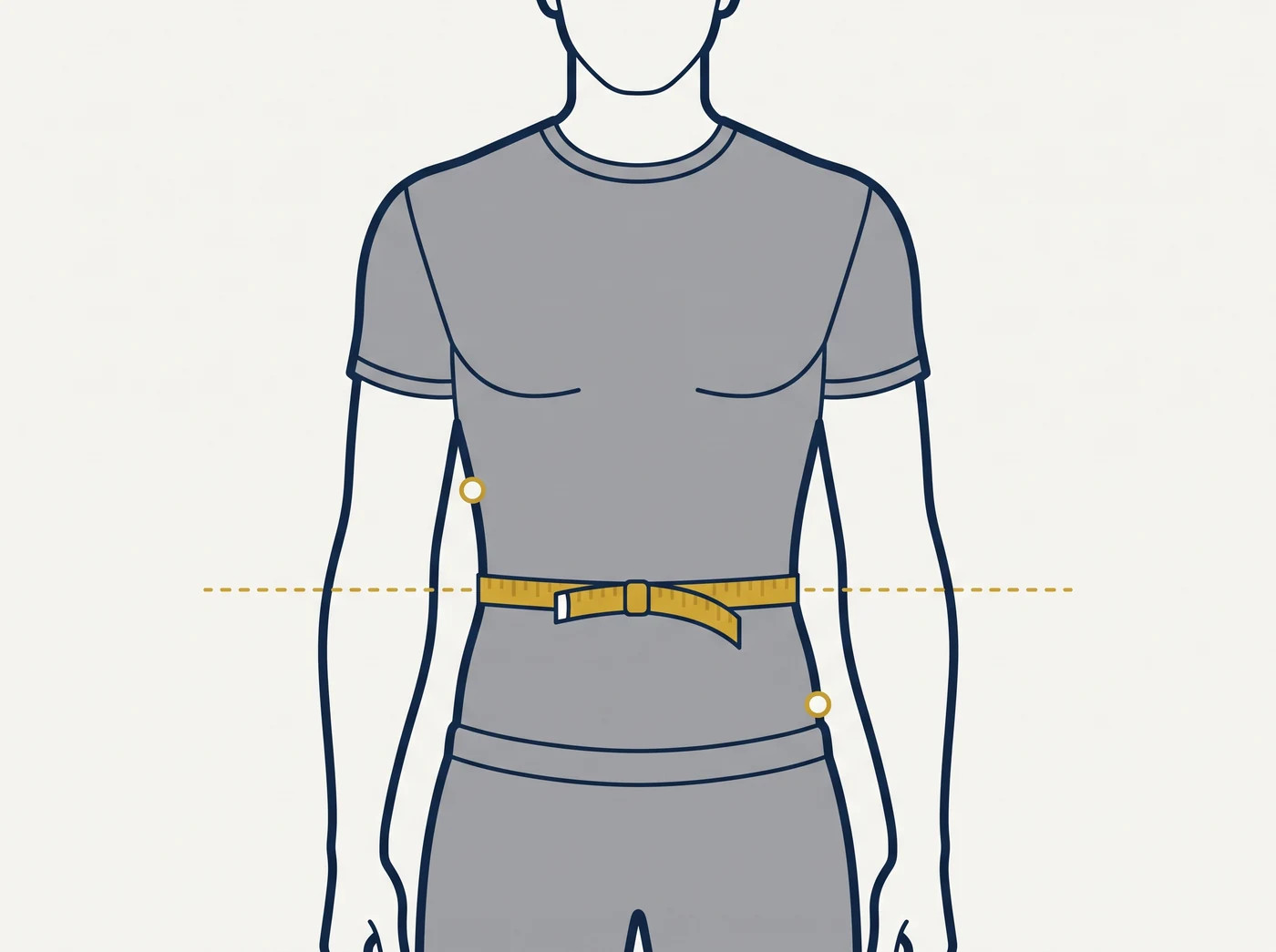
- Know the procedure: bare skin, right side, midpoint between the lowest rib and the top of the hip bone, feet no more than shoulder width apart, read at the end of a normal exhale; holding your breath or sucking in is not allowed ¶3.15.4.4–3.15.4.6. The full checklist is on the WHtR guide.
- Wear something easy to move. Any duty uniform is allowed for the body composition component ¶3.2.2; you adjust it so the tape sits on skin.
- Decide on decoupling. You may do the waist measurement at least one and no more than five duty days before the other components, or the same day; you cannot be directed either way ¶3.1.1, 3.4.3.
- Track the habits, not the daily tape. Re-measure about every two months to see real change (Playbook p. 20). When you do, take three readings and run them through the tape-readings tool so you see the number an administrator would record. The test-day guide covers the rest of the day.
If eating, weight or body image is becoming a struggle, talk to your provider early; you do not have to wait for a test. And if a medical condition affects your body composition, raise it with your provider too: a body composition exemption on the AF Form 469 has to be reviewed and approved by the AMRO Board ¶4.1.8.2.
Free Help
Military OneSource health and wellness coaching covers fitness, nutrition and weight management at no cost to eligible service members (800-342-9647). If you are in the Fitness Reconditioning Program, your options can include Military OneSource health coaching, fitness center exercise classes, medically approved nutrition courses and local FRP classes ¶5.6.5. For a plan built around you, the Playbook points to a registered dietitian (p. 18).
Frequently Asked Questions
How fast can I lower my waist-to-height ratio?+
What actually reduces waist circumference?+
Do ab exercises improve WHtR?+
How is the waist measured on test day?+
What WHtR do I need?+
Is cutting weight fast before the test a good idea?+
More in Body Composition
See exactly where you stand.
Enter your reps, times and waist measurement to get your 2026 PFRA score instantly.