The timed forearm plank is one of three core endurance events in the 2026 PFRA; the others are 1-minute sit-ups and the 2-minute cross-leg reverse crunch¶3.1.2.3. This page gives the chart minimum and full-points hold for every age group, the plank rules from AFMAN 36-2905 Attachment 2 (formerly DAFMAN 36-2905) and a free timer that tracks your points as you hold.
Forearm plank timer
1:35Max
3:40
Your chart
Male · Under 25: minimum 1:35 (2.5 pts), full points 3:40 (15 pts)
Forearm Plank Standards by Age and Gender (2026)
The chart minimum is the starred row and earns 2.5 points; the max is the hold that earns all 15. The charts move in 5-second steps, and anything shorter than the minimum scores zero for the component¶3.7.4.
| Age group | Male | Female | ||
|---|---|---|---|---|
| Min (2.5 pts) | Max (15 pts) | Min (2.5 pts) | Max (15 pts) | |
| Under 25 | 1:35 | 3:40 | 1:30 | 3:35 |
| 25–29 | 1:30 | 3:35 | 1:25 | 3:30 |
| 30–34 | 1:25 | 3:30 | 1:20 | 3:25 |
| 35–39 | 1:20 | 3:25 | 1:15 | 3:20 |
| 40–44 | 1:15 | 3:20 | 1:10 | 3:15 |
| 45–49 | 1:10 | 3:15 | 1:05 | 3:10 |
| 50–54 | 1:05 | 3:10 | 1:00 | 3:05 |
| 55–59 | 1:00 | 3:05 | 0:55 | 3:00 |
| 60 and over | 0:55 | 3:00 | 0:50 | 2:55 |
Min is the chart’s starred minimum (2.5 points); max is the value that earns the full 15. Values are hold times in minutes and seconds. Source: AFPC PFRA scoring charts, effective 1 March 2026 (corrected 17 March 2026).
Airmen who also take an occupationally specific assessment use AFPC’s sex-neutral AFSPECWAR/EOD charts¶1.3.3; for the plank those charts match the male column above.
The Official Forearm Plank Standard
The PFRA Administrator reads these instructions and demonstrates the position before the event¶3.15.4. Every rule below is from Attachment 2, paragraph A2.7.
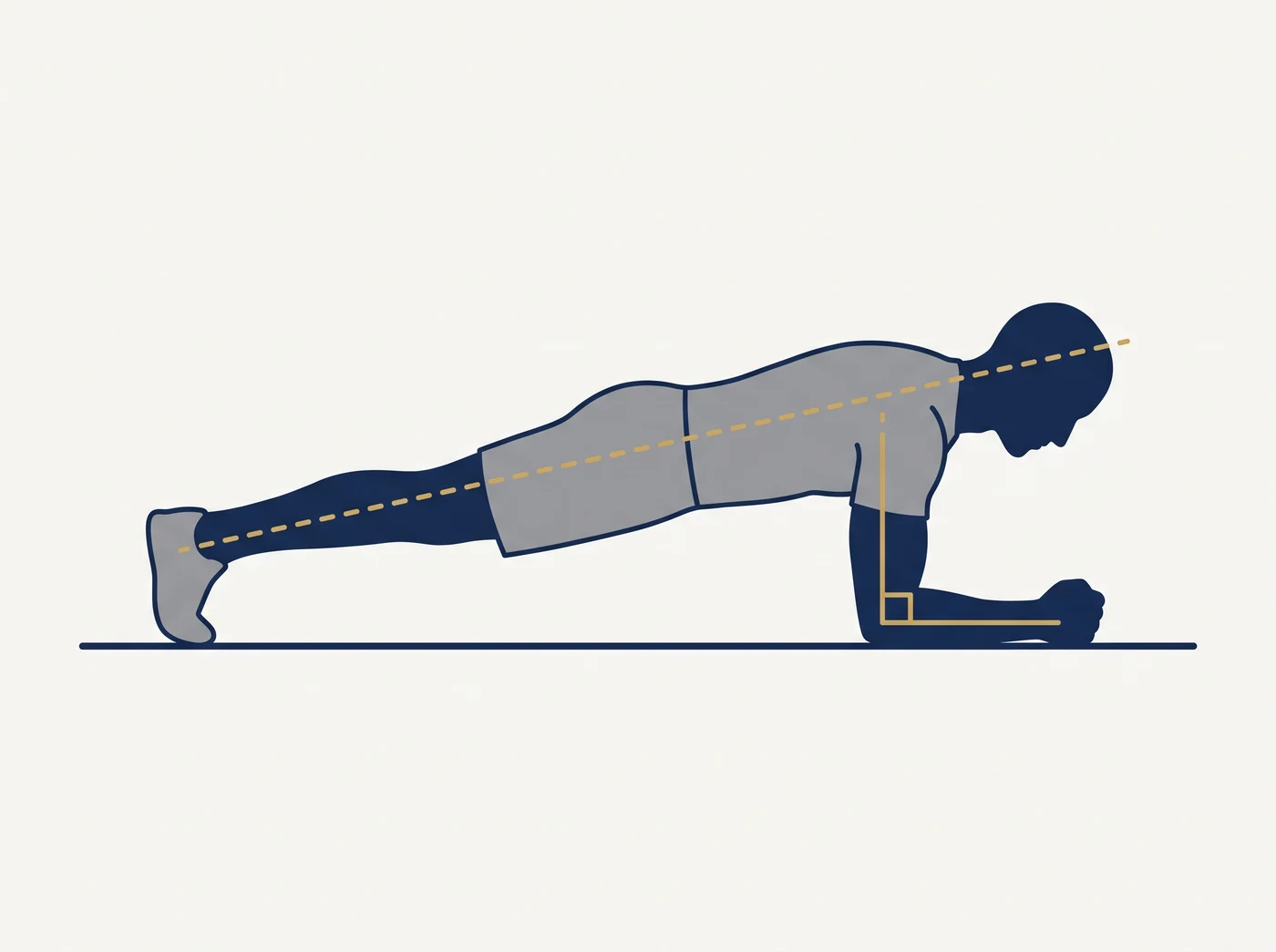
Forearm plank
Timed hold · A2.7- Surface
- A flat, level surface. A mat is allowed, but you must be entirely on it or entirely off it.¶A2.7.1
- Arms
- Face down, forearms flat on the floor, elbows directly below your shoulders at 90 degrees between forearm and upper arm. Hands in fists with the pinky side down, or flat with palms down. Forearms may be parallel or angled in; hands may not be clasped.¶A2.7.3, A2.7.4
- Body
- Feet hip-width apart. Hips off the ground, with only your forearms, hands and toes on the floor. Knees straight, pelvis neutral, back flat: a straight line from head to heels for the whole hold.¶A2.7.5
- Contact
- Toes, forearms and fists or palms stay on the floor or mat the whole time, without folding your hands.¶A2.7.6
- Shaking
- Involuntary shaking or trembling from maximum effort is expected and allowed while you keep the position.¶A2.7.7
- Ends the hold
- Any body part other than your hands, forearms or feet touches the floor; you lower your head to your hands; you lift your hands, forearms or feet; or you lose the 90-degree elbow by shifting your weight forward or back.¶A2.7.8
- Corrections
- You can receive two form corrections. The third stops the assessment, and the time at that moment is your official plank time.¶A2.7.9
- Timing
- Stopwatch to the nearest second. The administrator calls START and every 15 seconds.¶A2.7.2
A2.7.8 also ends the event when “maximum time for the forearm plank has elapsed” but does not say what that time is. Either way, the charts stop paying at the full-points hold for your age group.
Plank, Sit-Ups or Reverse Crunch?
The plank has no rep count to argue about: your score is the time on the stopwatch when the hold ends. It is not judgment-free, though. The administrator can correct your form, and the third correction stops the clock¶A2.7.9, so practice the exact test position rather than whatever plank feels strongest. The sit-up page compares all three core events side by side.
On Test Day
- Core endurance is the third component, after body composition and strength and before cardio¶3.15.4, with at least 5 minutes of rest between components¶3.15.10.
- You get one attempt¶3.15.13, and if you miss a minimum you are still expected to finish the remaining components¶A2.1.
- At the end the PFRA Administrator tells you your time. To dispute it, say so before the next component¶3.15.6.3.
The full sequence is in the test day guide.
Training for a Longer Hold
The Warfighter’s Fitness Playbook 2.0 (AFPC, February 2026, Appendix B) describes the forearm plank the same way it is tested: elbows under the shoulders, hands in fists, hips lifted into a straight line from head to heels, with the core engaged so the hips don’t rotate, arch or sag. Practice that position, not a wider or higher variation.
- Use the timer’s 15-second ticks so test day sounds familiar, and stop the clock the moment your form breaks, the way an administrator would.
- AFMAN Attachment 7 recommends muscular training 2 to 3 days a week without working the same muscle groups on consecutive days¶A7.2.4, in sessions under an hour¶A7.2.3.
- Write each timed hold on a practice worksheet so you can see the trend against your minimum and full-points times.
Related USAF PT Resources
Frequently Asked Questions
How long do you need to hold a forearm plank to pass the Air Force PT test?+
What is the correct forearm plank position?+
What ends the plank on test day?+
Is shaking allowed during the plank?+
How is the plank timed and scored?+
Can I use a mat for the plank?+
Can I choose sit-ups instead of the plank?+
More in 2026 Standards & Score Charts
See exactly where you stand.
Enter your reps, times and waist measurement to get your 2026 PFRA score instantly.