The 2-mile run is one of two cardio options on the 2026 Physical Fitness Readiness Assessment (PFRA) and is worth up to 50 of 100 points¶3.7.1. Run your age group’s minimum time or faster to earn at least 35 points; a slower time scores zero and fails the test, whatever your composite¶3.6.1, 3.7.4. The tools below turn the chart into a pace you can run.
- Points
- Up to 50 ¶3.7.1
- Minimum
- 35 points at your age group’s starred time
- 400 m track
- 8 laps plus 61 ft ¶3.13.2.1
- Alternative
- 20 m HAMR, your choice ¶3.1.2.4
- Order
- Last component, after body comp, strength and core ¶3.15.4
- Altitude
- Corrections at 5,250 ft or higher ¶3.15.12.3
2-mile pace planner
Scoring charts
Gender
Age group
Target
The slowest time that earns 35 points for Male · Under 25.
- Per mile
- 9:52
- Per km
- 6:08
- Per 400 m lap
- 2:27.3
| Points | 2-mile time |
|---|---|
| 35.5 pts | 19:08 – 19:36 |
| 35 ptsyours | 19:37 – 19:45 |
| 0 pts | slower than 19:45 |
Next row up: 19:36 for 35.5 points, 9 s faster.
Splits for 19:45
Eight laps plus 61 ft, the standard-track course in AFMAN para. 3.13.2.1.
Where you'll run
The extra 61 ft
Pacing
| Lap | Split | Elapsed |
|---|---|---|
| Lap 1 | 2:27.3 | 2:27 |
| Lap 2 | 2:27.3 | 4:54 |
| Lap 3 | 2:27.3 | 7:21 |
| Lap 4 | 2:27.3 | 9:49 |
| Lap 5 | 2:27.3 | 12:16 |
| Lap 6 | 2:27.3 | 14:43 |
| Lap 7 | 2:27.3 | 17:10 |
| Lap 8 | 2:27.3 | 19:38 |
| + 61 ft | 0:06.8 | 19:45 |
Keep going after your last lap: the final 61 ft take about 7 s at this pace, so you pass the 8th lap line at 19:38, not 19:45.
The AFMAN sets the distance¶3.13.2.1, not where the extra stretch goes. Check whether your course’s start line sits behind the lap line or the finish sits past it, and pick the matching option.
Testing at 5,250 ft or higher? The altitude correction shows how much slower you can run¶3.15.12.3.
2-mile or HAMR: which scores you more?
Scored for Male · Under 25
Total 20 m shuttles. Leave blank to skip.
5,250 ft or higher? Pick a group.
19:30meets the minimum
Not entered
- Your 19:30 is worth 35.5 points: the same as 44 to 45 shuttles on the HAMR.
| Points | 2-mile, slowest | HAMR, fewest |
|---|---|---|
| 50 | 13:25 | 87 |
| 49.5 | 13:44 | 84 |
| 49 | 14:03 | 81 |
| 48 | 14:22 | 78 |
| 47 | 14:41 | 75 |
| 46 | 15:00 | 72 |
| 45 | 15:19 | 70 |
| 44 | 15:38 | 67 |
| 43 | 15:57 | 65 |
| 42 | 16:16 | 63 |
| 41 | 16:35 | 60 |
| 40 | 16:54 | 58 |
| 39 | 17:13 | 56 |
| 38.5 | 17:32 | 54 |
| 38 | 17:51 | 52 |
| 37.5 | 18:10 | 51 |
| 37 | 18:29 | 49 |
| 36.5 | 18:48 | 47 |
| 36 | 19:07 | 46 |
| 35.5your run | 19:36 | 44 |
| 35 | 19:45 | 42 |
| 0 | slower | fewer |
Altitude correction for the 2-mile
Scored for Male · Under 25
2-Mile Run Standards by Age (2026)
Times are “or faster”. The minimum is the chart’s starred row and earns 35 points; any time at or under the maximum earns the full 50. In between, each chart row adds 0.5 or 1 point. These come from the AFPC PFRA charts effective 1 March 2026 (corrected 17 March 2026); the rules on this page come from AFMAN 36-2905 (24 March 2026), formerly DAFMAN 36-2905. Airmen who take the OSPFRA use the sex-neutral, age-normed AFSPECWAR/EOD chart¶1.3.3.
| Age group | Max (50 pts) | Min (35 pts) |
|---|---|---|
| Under 25 | 13:25 | 19:45 |
| 25–29 | 13:35 | 19:55 |
| 30–34 | 13:42 | 20:44 |
| 35–39 | 13:56 | 21:16 |
| 40–44 | 14:05 | 22:04 |
| 45–49 | 14:30 | 22:27 |
| 50–54 | 15:09 | 22:50 |
| 55–59 | 15:28 | 23:36 |
| 60 and over | 16:58 | 24:00 |
| Age group | Max (50 pts) | Min (35 pts) |
|---|---|---|
| Under 25 | 15:30 | 25:23 |
| 25–29 | 15:55 | 25:40 |
| 30–34 | 16:10 | 26:15 |
| 35–39 | 16:12 | 26:30 |
| 40–44 | 16:45 | 26:52 |
| 45–49 | 16:55 | 27:15 |
| 50–54 | 17:10 | 28:05 |
| 55–59 | 17:43 | 28:40 |
| 60 and over | 18:20 | 29:40 |
| Age group | Max (50 pts) | Min (35 pts) |
|---|---|---|
| Under 25 | 13:25 | 19:45 |
| 25–29 | 13:35 | 19:55 |
| 30–34 | 13:42 | 20:44 |
| 35–39 | 13:56 | 21:16 |
| 40–44 | 14:05 | 22:04 |
| 45–49 | 14:30 | 22:27 |
| 50–54 | 15:09 | 22:50 |
| 55–59 | 15:28 | 23:36 |
| 60 and over | 16:58 | 24:00 |
Need a specific row? Pick a chart and age group to list all 21 rows.
Official sources: AFPC PFRA scoring charts (PDF) and AFSPECWAR/EOD charts (PDF). Every event in one place: the score charts, the PT test minimums and the full PT score calculator.
Course and Test-Day Rules
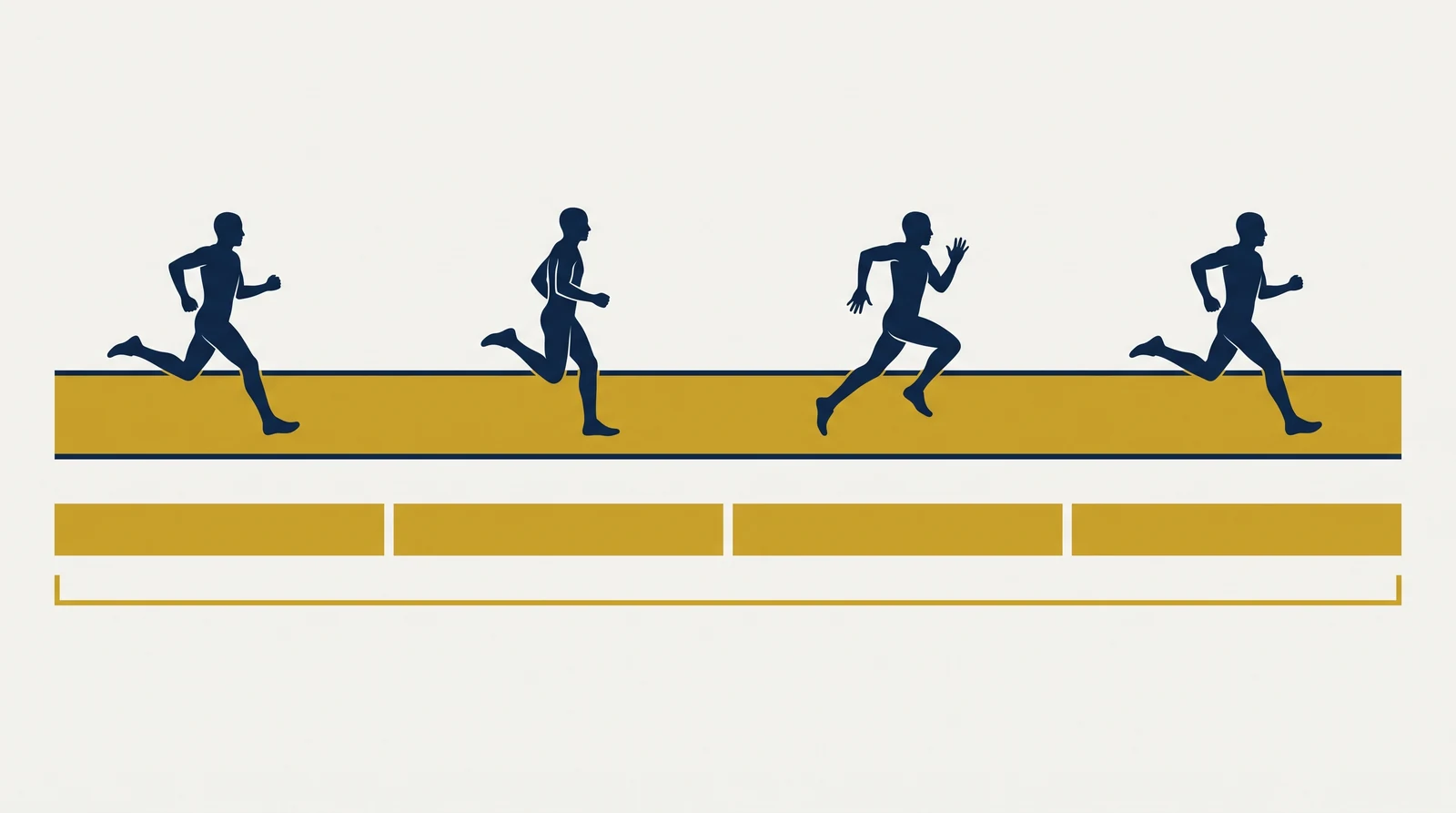
The course
- On a standard 400 m track the run is eight laps plus 61 feet¶3.13.2.1. On any other track or route it is 3,520 yards or 3,219 meters¶3.13.3.1.
- Courses are measured accurately, kept as level and even as possible, and certified to USA Track & Field guidelines with local CES, FSS and Wing Safety procedures¶3.13.1. The installation commander approves cardio courses¶2.14.7.
- No continuous incline, decline or rolling hills, and no slopes over two degrees. Indoor tracks with banked corners are authorized¶3.13.3.2 if installation leadership approves them and they are certified to the same standard¶3.13.6.
- Road courses start and finish in the same place where possible, with the start, finish and halfway point clearly marked¶3.13.3.3. Basketball courts are not authorized¶3.13.3.4.
- Trained personnel watch every runner, count laps and record results¶3.13.5.
What the administrator tells you
Before the run, the administrator reads the verbal instructions in Attachment 2A2.8.1:
- You may warm up for up to three minutes before you start. Members should warm up before the assessment¶3.15.12.2.
- Line up behind the start line. You start when the administrator starts the stopwatch.
- No physical assistance from anyone or anything. Pacing is allowed if there is no physical contact and it doesn’t hinder other runners; you can ask for a pacer¶3.15.12.4.
- Stay on and complete the entire marked course. Leaving the course is disqualifying and ends the assessment.
- Your time is recorded when you cross the finish line. Then cool down for about five minutes.
- If you feel unwell at any point, stop running immediately and you will be given assistance. Report unusual shortness of breath, chest pain, dizziness or light-headedness to the administrator right away¶3.15.14.
Timing, order and attempts
- Cardio is the last component¶3.15.4, after at least five minutes’ rest¶3.15.10, and all physical components must finish within three hours of starting the first¶3.15.9.
- The administrator runs two stopwatches (primary and backup) and may call out elapsed time¶3.15.5. You’re told your time at the end; to dispute it, say so before the next component, and mark “Dispute results” on the AF Form 4446 if it isn’t resolved¶3.15.6.3, 3.15.15.
- You get one opportunity at each component per assessment. If you quit because you missed a minimum, the PFRA is recorded as Did Not Finish¶3.15.13, which results as Unsatisfactory¶3.10.4.
Weather and safety limits
The course and the weather must be inside these limits. Weather is checked with base weather, environmental engineering or civilian agencies before any outdoor component starts¶3.14.8.
- Running surface
- No snow or ice build-up, no standing water a group can't easily avoid, and no mud that can't be easily avoided.¶3.14.1–3.14.3
- Rain
- No significant rain (0.10 in per hour or more).¶3.14.8.1
- Lightning
- None within 5 nautical miles; wait at least 30 minutes after the last observed lightning.¶3.14.8.2
- Hail
- None forecast or reported within 25 miles.¶3.14.8.3
- Wind
- No more than 15 mph sustained or 20 mph gusting.¶3.14.8.4
- Cold
- Air temperature above 34°F, including wind chill.¶3.14.8.5
- Heat
- Wet bulb globe temperature should be 86°F or lower, above all during cardio; where humidity is under 40%, dry bulb should be under 90°F.¶3.14.8.5
- Near traffic
- Visibility over ¾ mile, reflective belts or vests from one hour before sunset to one hour after sunrise, and crossing guards at active intersections.¶3.14.4–3.14.5¶3.14.8.6
- Medical
- An AED in the building or within 100 feet until everyone has left.¶3.14.6
During continuous extreme climate conditions, wing, GSU or detachment commanders may waive outdoor cardio assessments when no appropriate indoor facility is available; while a waiver is in effect, members take the 20 m HAMR if a certified indoor course exists¶4.4.1, 4.4.1.2. Commanders should suspend PFRAs for unique circumstances such as an Air Quality Index above 100 or wildfires¶4.4.2. For the rest of the day, see the PT test day guide.
Train for It
The official training reference is the Warfighter’s Fitness Playbook 2.0 (February 2026, PDF). Its 2-Mile Run Program (Appendix A5) is an 8-week walk-run progression for Airmen coming back to running that ends with a mock 2-mile, and Appendix A7 adds goal-pace intervals for the run.
For a plan built around your current time, read how to improve your 2-mile run time, and for all four components at once, the 12-week PT test training plan. If the HAMR suits you better, see the HAMR standards.
Frequently Asked Questions
What is the minimum 2-mile run time by age?
How many points is the 2-mile run worth?
What pace per mile do I need for the 2-mile run?
How many laps is the Air Force 2-mile run on a track?
How does the altitude correction work for the 2-mile run?
Should I run the 2-mile or do the HAMR? Do I have to run the 2-mile once a year?
Can I walk instead of running the 2-mile?
What happens if I stop or step off the course during the run?
When did the Air Force switch to the 2-mile run?
More in 2026 Standards & Score Charts
See exactly where you stand.
Enter your reps, times and waist measurement to get your 2026 PFRA score instantly.